Film & Anime
Two screen traditions that kept borrowing from each other
The live-action canon is fundamentally noir: a detective figure, a compromised city, an investigation that turns out to be about the investigator. The animation canon inherited that iconography and then went somewhere the live-action films mostly declined to follow — into sustained, unhurried argument about what a mind is once it can be copied.
The ancestors
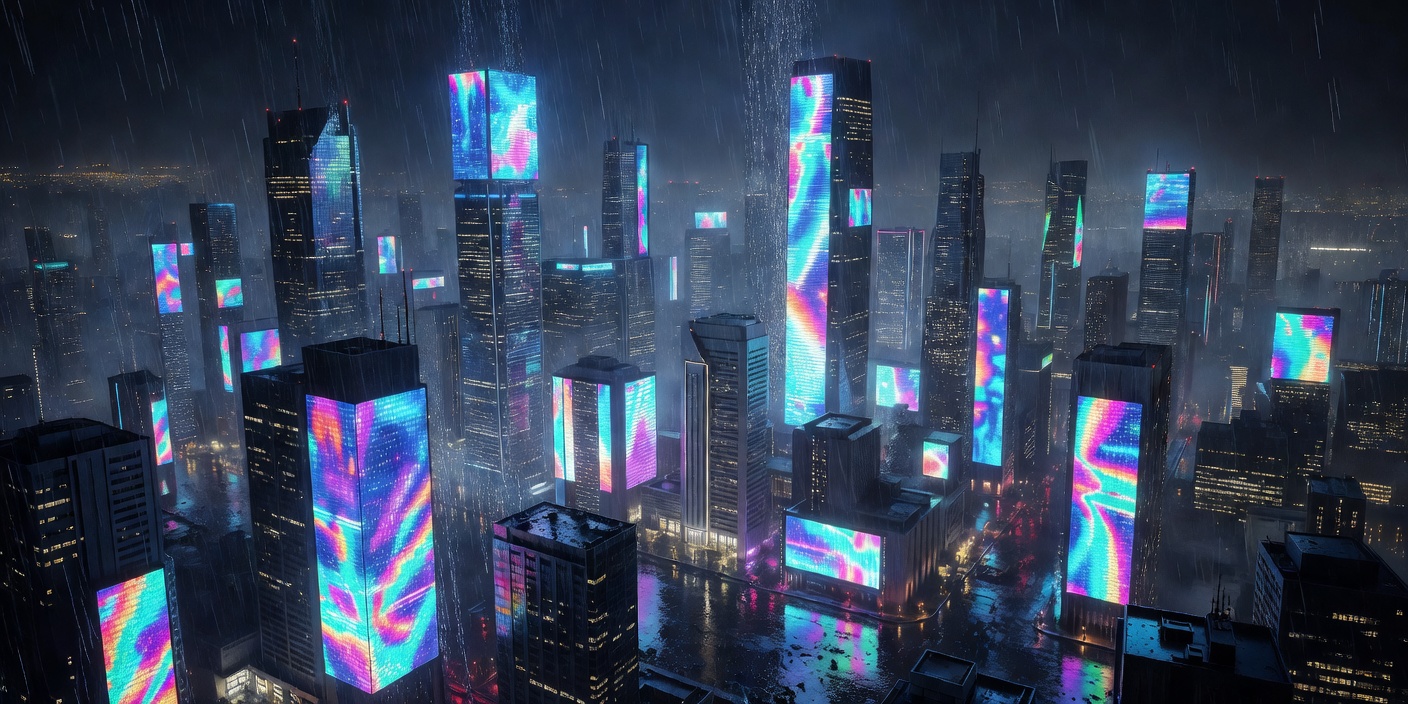
Metropolis supplies the vertical class diagram — machine level below, gardens above — and the false human built to manipulate a crowd. Its influence is structural rather than stylistic, and you can see the diagram redrawn in almost every arcology on screen since. The other ancestor is film noir itself: low key lighting, venetian blind shadows, voiceover, and a hero whose competence does not protect him. Cyberpunk cinema is largely noir with the moral ambiguity relocated from the characters to the technology.
Blade Runner and its long shadow
Ridley Scott's adaptation of Philip K. Dick's Do Androids Dream of Electric Sheep? did three things that nothing since has undone. It made the city a retrofit rather than a clean build — new equipment bolted onto old fabric, ducting on the outside, the future as accumulated sediment, with production design led by Syd Mead and Lawrence G. Paull. It made advertising the dominant light source. And it took a genre plot about hunting fugitives and made the emotional weight sit with the hunted.
Denis Villeneuve's Blade Runner 2049 is the rare sequel that argues with its predecessor rather than repeating it: emptier frames, colder palette, and a protagonist whose central discovery is that he is not special. Where the first film asks whether the replicant is human, the second asks whether it matters to anyone with power.
The live-action line after that
The results are uneven, and the interesting failures are worth as much as the successes. Strange Days puts recorded experience on the market and is unusually clear-eyed about who gets hurt when memory becomes a commodity. Johnny Mnemonic adapts Gibson's short story and demonstrates how badly the prose translates when its irony is played straight. The Matrix folded cyberpunk iconography into action cinema so effectively that for a generation the coat and the sunglasses are the genre — worth revisiting for how carefully its rules about the simulation are laid out before they are broken. Cronenberg's body-horror films sit adjacent rather than inside: Videodrome's flesh-and-signal fusion is a different anxiety, but the genre has been raiding it ever since.
A useful test when placing a borderline film: is there a functioning economy with owners in it? Post-apocalyptic and pure AI-thriller films often share the visual language but have no corporate order for characters to push against, and that order is what turns style into cyberpunk.
The Japanese animation line
Akira, Katsuhiro Otomo's adaptation of his own manga, is the pivot. Its Neo-Tokyo is a city of construction hoardings, protest and military containment rather than a mood board, its animation carries a specificity of movement that the medium had not attempted at that scale, and Geinoh Yamashirogumi's score replaced expected synth textures with percussion and voice. Even people who have never seen it recognise the bike slide.
Ghost in the Shell, adapted by Mamoru Oshii from Masamune Shirow's manga, is the other pillar and the more philosophical one. It slows down, lets long wordless sequences carry the argument, and treats the question of whether a fully prosthetic body still houses a person as a genuine open problem rather than a twist. Kenji Kawai's score, built on choral chant, is doing as much thematic work as the dialogue. The Stand Alone Complex television series then spread the same material across procedural episodes and a longer conspiracy arc, which suits the subject: surveillance stories work better at length.
Series worth the time
- Serial Experiments Lain — network identity and dissociation, told in an elliptical style that rewards patience more than explanation.
- Psycho-Pass — predictive policing and the machinery of a scored society, structured as a procedural so the system stays in frame.
- Ergo Proxy — domed city, artificial servants, deliberately dense with allusion; the slowest of the group.
- Texhnolyze — an underground city and prosthetic labour, bleak and almost dialogue-free in stretches.
- Bubblegum Crisis — earlier, pulpier, and a clear line back to the powered-armour and rogue-android strand.
- Cyberpunk: Edgerunners — Studio Trigger's take on the Cyberpunk setting, working at maximum velocity and colour saturation.
Manga and comics adaptations
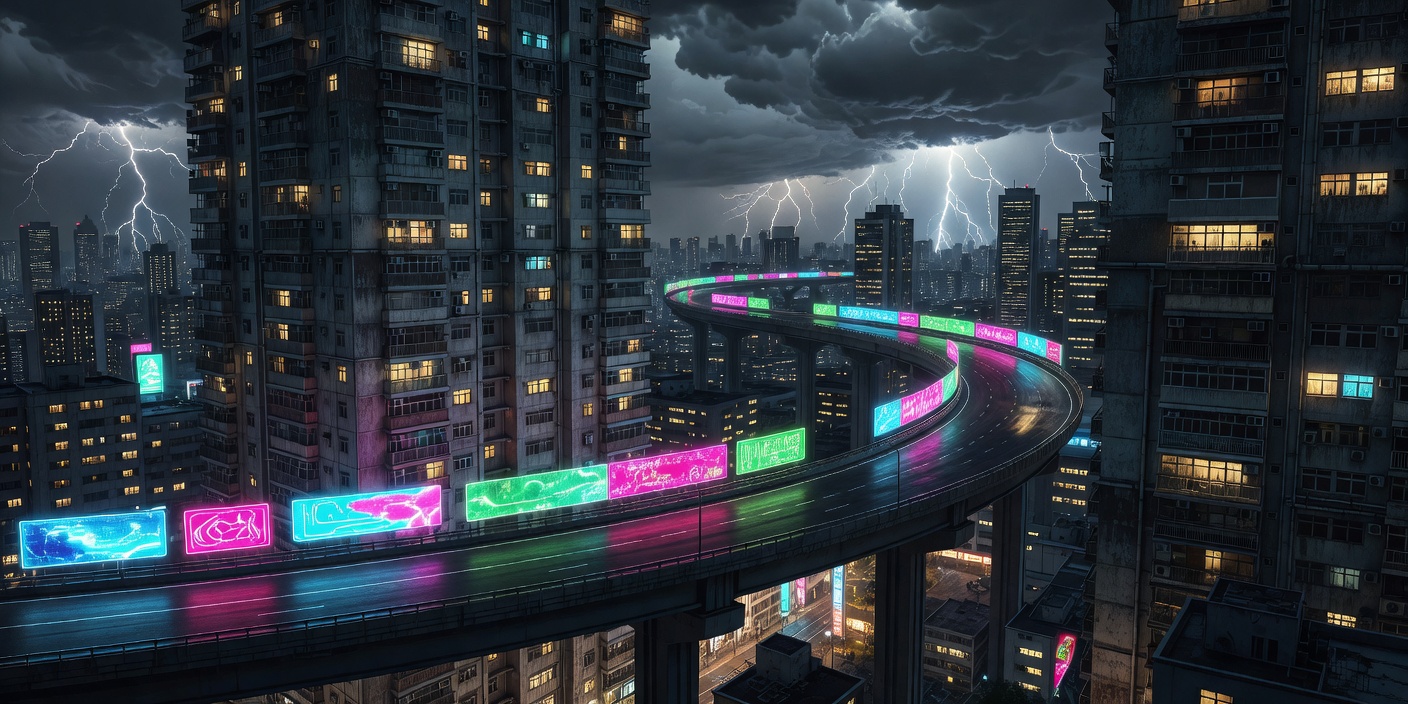
Battle Angel Alita, from Yukito Kishiro's manga, delivers the scrapyard-and-floating-city class structure with unusual clarity, and its live-action adaptation as Alita: Battle Angel is a fair test case for how much of that texture survives photorealism. Blame!, from Tsutomu Nihei, replaces the wet street with endless architecture and near-silence — a reminder that the genre does not require neon at all. Transmetropolitan, written by Warren Ellis with art by Darick Robertson, moves the register to gonzo journalism and keeps the politics front and centre.
Where to start
If you want the visual grammar in one sitting, Blade Runner. If you want the argument, Ghost in the Shell. If you want the genre at full energy, Akira. If you have seen all three and want the version that questions them, Blade Runner 2049 followed by Stand Alone Complex. Watch subtitled where you can — a good deal of the exposition in the animation line is written to be read at speed, and the dubs vary in how much they compress.
For the design language these films established, see the aesthetic guide; for the source fiction, the reading guide.