Games
The cyberpunk game lineages, and what each one is for
Setting is the easy part. Chrome, rain and a corporate skyline can be painted onto any genre. What separates the games that matter is whether their systems argue the same thing their fiction does — that infrastructure can be misused, that bodies are equipment, and that the people with the best gear are rarely the protagonists.
The immersive sim spine
The strongest line runs through the immersive sim. System Shock put you alone on a station with an artificial intelligence that had already won, and made audio logs carry the story so that exploration and narrative were the same activity. Its sequel tightened that into an RPG shell with genuine resource anxiety. Deus Ex then took the same design philosophy down to street level, and set the pattern most cyberpunk games still follow: hub districts, multiple approach vectors into every space, and augmentations that define a build rather than decorate one.
Human Revolution and Mankind Divided revived the structure with better spatial design than the original could manage — Mankind Divided's Prague hub is arguably the densest playable cyberpunk city ever built, with vertical routes threaded through apartment blocks and service ducts. The trade-off is structural: both games sell you a stealth-and-persuasion fantasy and then, at points, ask you to win a fight that no stealth build is equipped for, and the second game's story stops rather than ends.
What to look for in this lineage: does the level have at least three ways in, and does the game let you fail forward? If the answer is a single scripted vent, the immersive sim label is marketing.
Tabletop is where the vocabulary came from
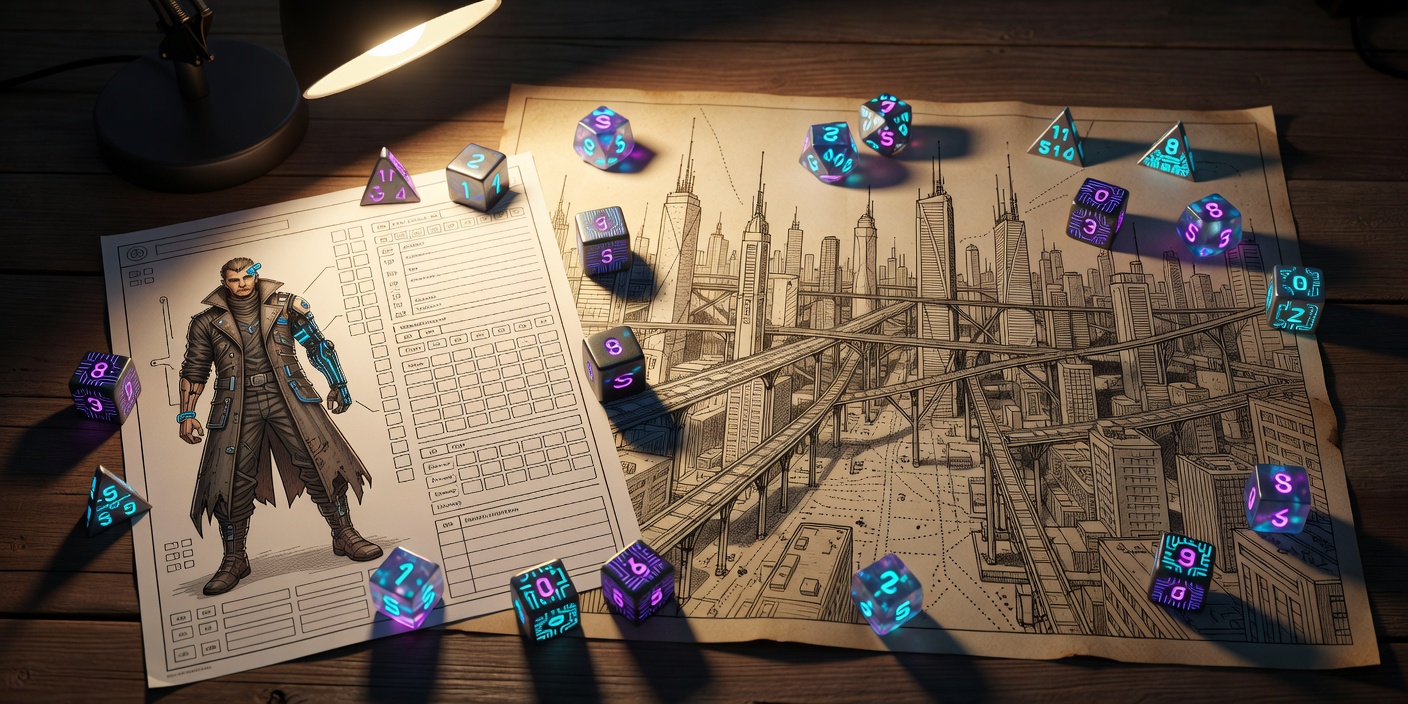
Netrunner, ripperdoc, edgerunner, chrome — a great deal of the genre's working jargon was codified at the table. Mike Pondsmith's Cyberpunk line for R. Talsorian Games built the Lifepath system, which generates a character's family, debts and enemies before you touch a skill, and paired cyberware with Humanity cost so that every upgrade carries a price in personality. Cyberpunk RED continues that design in a rebuilt, tighter form.
Shadowrun's contribution is the hybrid: corporate dystopia plus magic, with Essence as the analogous currency spent on augmentation. Its enduring appeal is the run structure — legwork, plan, execution, fallout — which is a better template for cyberpunk plotting than anything the video games invented. Harebrained Schemes' Shadowrun Returns, Dragonfall and Hong Kong translate that structure to turn-based tactics; Dragonfall in particular understands that a run is mostly conversation.
If you are picking a ruleset: Cyberpunk RED is the leaner system with a tight geographic focus. Shadowrun carries more setting and more subsystems, and rewards a group willing to learn them. Both put a cost on augmentation, and that mechanic is doing thematic work — treat it as a feature, not friction.
The adventure and visual-novel branch
This is the branch people skip, and it contains some of the genre's best writing. Snatcher borrowed its plot engine openly from Blade Runner and delivered it as a text-and-menu adventure with unusually confident scene-setting; Policenauts extended the approach with a more procedural, investigative frame. Beneath a Steel Sky pairs point-and-click puzzles with a stratified city where your position in the tower is your position in society, with comics artwork by Dave Gibbons. Westwood's Blade Runner adaptation deserves its reputation for making replicant identity genuinely variable across playthroughs rather than a single scripted twist.
The modern descendants trade puzzles for conversation. VA-11 Hall-A puts you behind a bar and delivers the whole city through the people who drink in it, with drink-mixing as the only mechanic. 2064: Read Only Memories runs a more traditional adventure structure around a machine intelligence asking to be treated as a person. Both are short, both are dense, and both are better on theme than most games ten times their scale.
Open worlds, action and mood
Cyberpunk 2077 adapts Pondsmith's tabletop setting and is at its strongest in its side stories and its architecture rather than its main plot; treat it as a city to inhabit and it holds up far better than treating it as a shooter. The Ascent uses an isometric camera to make the arcology feel genuinely stacked. Ghostrunner strips the genre back to movement and one-hit lethality. Cloudpunk is a delivery job with a skyline and a conversation, and is unembarrassed about being mostly atmosphere. Watch Dogs took surveillance as its central mechanic — worth playing precisely to see where a one-button hack helps the theme and where it flattens it.
Hacking as a verb
Most games render intrusion as a timed minigame. A few make it the actual activity. Uplink treats you as a contractor working through a desktop of hired tools and log traces, so the tension is administrative rather than combative. Hacknet leans on real command-line syntax. Quadrilateral Cowboy hands you a deck and a script editor and lets you write short programmes to open doors on a delay — one of the few designs where the fiction of "the street finds its own uses" is literally the input method. Invisible Inc. abstracts it into turn-based programme costs that you spend against an escalating alarm.
Choosing where to start
This is an editorial selection organised by what you want from a session, not a ranking.
| If you want | Strand | Reasonable first stop |
|---|---|---|
| Systems that reward planning | Immersive sim | Deus Ex, then Mankind Divided for the city |
| Writing and mood over mechanics | Adventure / visual novel | VA-11 Hall-A or Snatcher |
| Setting depth you can build on | Tabletop | Cyberpunk RED or Shadowrun |
| Reflex, speed, short sessions | Action | Ghostrunner |
| A city to wander | Open world | Cyberpunk 2077, side content first |
| Intrusion as the whole game | Hacking sim | Quadrilateral Cowboy or Uplink |
Cross-reference as you go. The themes guide covers why augmentation costs are usually framed as loss, and the reading guide traces the fiction most of these designs are quoting.